
I’ve spent three decades in the media, hospitality, and destination event communications space, and I’ve seen the transformation of live events, festivals, and club culture firsthand. My clients and I share a common, painful truth: “Everything is content” has become the enemy of genuine experience.
The shift is palpable. It’s the journey from the primacy of the DJ as the spiritual conductor of the experience to the DJ as the prop in a viral video. It’s the uncomfortable feeling when organizers, while defending the need for viral captures, confess that the swarm of cameras has fundamentally shifted—and often shattered—the energy of the entire night.
Arguably, you simply cannot have an authentic experience with a camera in your hand, your brain anticipating the next “it” moment that’s worth posting. You are no longer living; you are merely collecting.
This is more than a cultural trend; it’s a professional and ethical crisis that impacts event organizers, artists, and the entire audience.
The Digital Barrier: From Immersion to Isolation
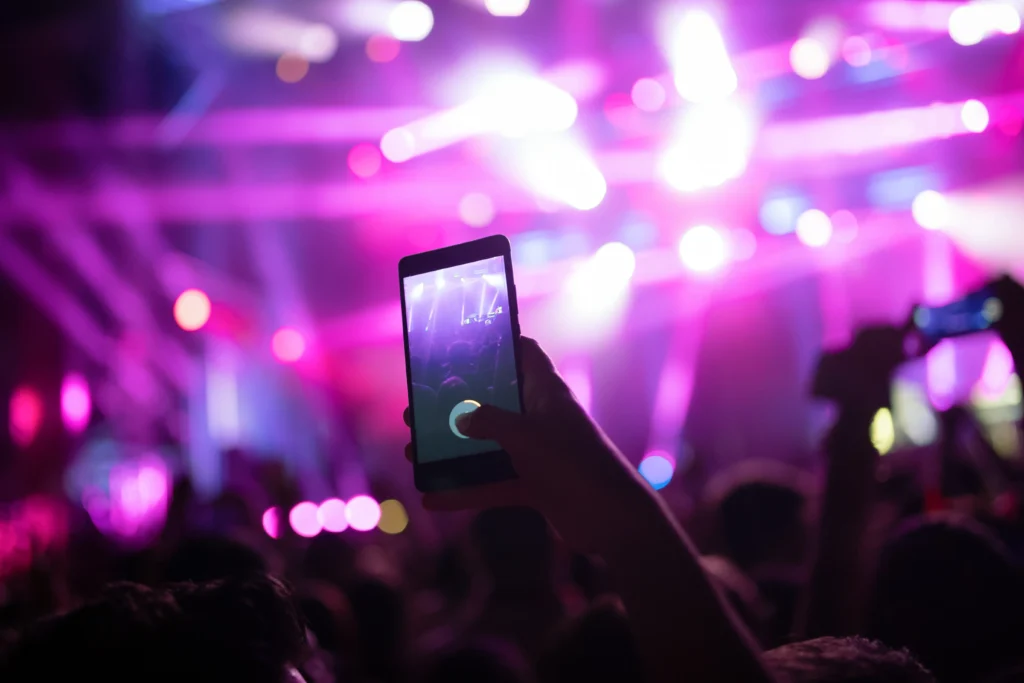
The job of a professional media team is to capture the experience with the brand in mind. However, the ubiquitous presence of audience cameras creates a digital barrier that isolates the performer and the crowd.
1. The Artist’s Crash
While a sea of cameras held high can initially deliver a performer’s dopamine hit—a visible sign of engagement—that high quickly crashes when the artist realizes they cannot truly engage.
- The Focus Problem: If everyone has a camera or phone in their hand, what are they actually focusing on? Not the subtle shifts in the mix, not the collective energy of the room, but the framed, filtered shot on their screen.
- The Loss of Key Moments: Artists rely on eye contact, physical feedback, and spontaneous reaction to build key moments in a performance. When the audience is physically present but psychologically absent—their attention directed toward a screen—the magic fails to catalyze. The connection dies in transit.
2. The DJ as Prop: Segmentation and Spectacle
The shift in capture has profoundly changed the DJ’s role. They are no longer the atmospheric architect; they are the focal point, the human prop, the centerpiece of a highly curated spectacle.
- The Boiler Room Effect and Entitlement: The new norm, often seen in setups reminiscent of certain streamed events, is the small, self-absorbed group of “internet stars”—often popping bottles or performing highly segmented, visible luxury—behind the DJ. Insight: This creates a profound segmentation between the audience. This unspoken message—”Our curated consumption is the actual show”—is sent to those watching from the dwindling dance space.
- The Real Estate Theft: The dance floor itself is shrinking. Its sacred real estate is being eaten up by hookahs, tables, sections, and skyboxes. The purity of the collective physical experience has been usurped by the demand to curate the idea of luxury for an unseen audience suffering from FOMO. The space is no longer for dancing; it is for posing.
The Great Lie of the Live Experience
This aesthetic-over-experience economy begs a fundamental question for the modern consumer: Why should I attend?
Social media has condensed the lived moment into 15-second highlight reels and endless live streams. I have to ask myself why I should spend an astronomical amount of money on tickets, flights, and mid-bar liquor for an over-crowded experience that prioritizes aesthetics over actual enjoyment, when I can watch a higher-quality, live-streamed version from the comfort of my home drinking my own store-bought liquor.
Social media, in this context, is the theft of human experience. It is the robbing of intimate, spontaneous moments—both personal and collective.
Ethical Communications & The Trust Deficit
The crisis of authenticity is magnified by the shift in communication support. As a media professional covering large-scale projects, I am always mindful of what I capture and what I hold back to build and hold my audience’s trust. But many actors in the ecosystem do not share this code.
1. Consumer Expectation and Consent
Because of the pervasive nature of social media, social norms have changed; people now anticipate and even expect to be captured.
- Professional Counsel: As a communication advisor, I often encourage my clients to put verbiage in their online ticketing agreements and at entry points about visual captures, use, and expectations. This transfers liability and, more importantly, sets the right tone: You are here to experience, not just to document.
- The Media Team’s Role: Your media team’s professional, high-quality capture should serve the brand’s needs, freeing the audience to put their own phones away. This is the media team’s purpose—to capture the story so the audience can live it.
2. The Trust Deficit of the Paid Messenger
As a consumer, I hold an absolute distrust for the influencer who is flown in to cover an event.
Insight: Anyone who is paid by an organization to cover an event is, by default, obligated to only share positive aspects or position the brand in a positive light.
This creates a trust deficit. The audience knows the messenger’s loyalty is to the paycheck, not the truth of the experience. The integrity of the coverage is compromised, further blurring the line between genuine reportage and pure propaganda.
Reclaiming the Experience: The Physical and Ethical Solutions
While we cannot ban phones completely, we can—and must—limit access and reshape the physical space to prioritize the flow state.
- Create “No-Phone Zones” in Front of the Stage: This is the critical first step. Designate a specific, vibrant area immediately in front of the performer where phones must be stowed, either in locked pouches or simply through strict enforcement. This gives the performer back the ability to engage and gives the attendee back their own presence.
- Redesign the Venue Layout: We must prioritize the collective energy of the dance. Recommendation: Give the dance floor back. Center the entire venue design around an open, accessible dancing area. Relegate skyboxes, tables, sections, and cabanas to the perimeter of the venue space. This creates an authentic core experience while still accommodating the demand for premium, luxury viewing.
- The Golden Rule of Consent (Revisited): As event organizers and professionals, we must continue to enforce the highest ethical standards. The experience is about the community, not the capture.
Everything is content, yes, but we must decide what kind of content we want to be. Do we want to be performers in a shallow, curated highlight reel, or do we want to be participants in a deep, vibrant, and genuinely human experience? The answer will define the culture of the next three decades.
“COLLECTING IS NOT LIVING.”
Operational Summary: This article deconstructs the shift from the DJ as spiritual conductor to the DJ as a prop. We expose the “Digital Barrier” that isolates performers from their crowd and the “Real Estate Theft” where dance floors are consumed by hookah tables and VIP skyboxes. We offer a professional and ethical solution: Give the dance floor back to the people.
Key Technical Solutions:
- The Artist’s Engagement Fix: Removing the screen-barrier to allow spontaneous connection.
- Sovereign Space Architecture: Centering venue designs around the open dance floor, not the perimeter sections.
- The Media Team’s True Purpose: Professional capture should serve the brand so the audience doesn’t have to.
Q: What is the ‘Theft of Experience’ in festival culture? A: The “Theft of Experience” refers to the erosion of genuine human connection in live events due to the obsession with capturing content for social media. As The Architect explains, when attendees focus on their screens rather than the performance, they become “psychologically absent,” turning the event from a shared ritual into a shallow, curated spectacle.
Q: How can event organizers solve the phone-camera crisis? A: Organizers can solve this by implementing Brand Infrastructure Engineering solutions: designating “No-Phone Zones” in front of the stage, redesigning venue layouts to prioritize the dance floor over VIP sections, and providing high-quality professional media captures that allow the audience to remain in the moment.