Defining the Sound: The Kinetic Energy of the Caribbean
To the uninitiated, Soca music is an overwhelming wall of celebration. It does not invite passive listening; it demands physical movement. Structurally, the sound is anchored by a relentless, synthesized or acoustic four-on-the-floor bass drum pattern, overlaid with complex, syncopated snare rolls, rapid-fire hi-hats, and explosive horn lines.
At the core of any authentic Soca production is the “engine room”—the percussion section consisting of brake drums (iron), steelpans, cowbells, and congas. This acoustic drive provides a raw, metallic texture that cuts through modern electronic synthesizers, creating a sonic landscape that feels simultaneously futuristic and deeply ancestral.
Deconstructing the Misclassification: Soca vs. Reggae
Mainstream western media routinely commits a foundational error: grouping all English-speaking Caribbean music under the umbrella of “Reggae.” Sonically and culturally, Reggae and Soca occupy completely different spaces within the audio architecture.
- Reggae: Birthed in Jamaica, Reggae operates on a mid-to-slow tempo cadence (typically 80–110 BPM). Its structural foundation relies on the “one-drop” drum rhythm, where the emphasis falls heavily on the third beat of the bar, paired with hypnotic, syncopated basslines and rhythmic guitar stabs (the skank). It is music designed for reflection, resistance, and steady grooving.
- Soca: Conversely, Soca is built entirely on acceleration and forward momentum. Operating at tempos ranging from 120 BPM (Groovy) up to an intense 160+ BPM (Power), Soca shifts the weight to a continuous, driving pulse. While Reggae creates space between the beats, Soca aggressively fills those spaces with rhythmic density, engineered explicitly to fuel the mass choreography of Carnival street parades.
The Invisible Genre: The Chart and DSP Disparity
Despite driving multi-million-dollar festival economies globally, Soca music faces structural erasure across major Digital Streaming Platforms (DSPs), commercial radio directories, and charting bodies like Billboard.
Because platform architectures often lack a dedicated, high-level taxonomy for Soca, artists are forced to upload their works under metadata tags like “Reggae,” “Afrobeats,” or the highly reductionist “World Music.” This creates a severe distribution bottleneck:
- Algorithmic Dilution: Recommendation engines serve Soca tracks to users expecting roots reggae, leading to skips that penalize the track’s algorithmic authority.
- Data Fragmentation: Streams are split across conflicting genres, making it nearly impossible for Soca tracks to accurately aggregate metrics and claim positions on national definitive charts.
- Curatorial Neglect: Without standalone genre directories, major editorial playlists remain scarce, keeping the music siloed from mainstream global listeners.
The Historical Blueprint: From Lord Shorty to the Global Stage
The foundations of the sound were laid in Trinidad and Tobago during the early 1970s by Garfield Blackman, known culturally as Lord Shorty. Recognizing that traditional Calypso was losing ground to imported American soul and Jamaican reggae, Shorty engineered a deliberate sonic intervention.
By fusing the African-derived polyrhythms of Calypso with East Indian musical structures—utilizing instruments like the dholak, dhantal, and mandolin—he created a unified Trinidadian soundscape. Originally coined by Shorty as “Solka” (the soul of Calypso), the genre eventually evolved into the phonetic spelling: Soca.
Through the 1980s and 1990s, the sound digitized. Artists like Superblue and Machel Montano introduced synthesized drums and stadium-level arrangements, splitting the genre into two definitive tiers: Power Soca (designed for jumping and waving cloths in high-intensity festival arenas) and Groovy Soca (slower, more melodic, focusing on smooth transitions and infectious baseline patterns). Today, pioneers like Bunji Garlin, Voice, and Nailah Blackman continue to push boundaries, blending elements of trap, electronic dance music (EDM), and Afrobeats to claim mainstream visibility.
The Regional Matrix: Variations Across the Carnival Map
While Trinidad and Tobago remains the historical epicenter, the Carnival culture spans the entire Caribbean archipelago, with each island modifying the sonic blueprint to reflect its local identity:
- Barbados (Bashment Soca): Stripped down, aggressive, and highly kinetic, this variant heavily prioritizes raw dancehall riddims and street-level basslines, custom-built for the Crop Over festival.
- St. Vincent (Ragga Soca): A melodic fusion that blends the smooth, narrative lyrical delivery of dancehall with the sweeping chord progressions of groovy soca.
- Grenada (Jab Jab Rhythms): Dominated by dark, hypnotic, and repetitive horn loops alongside heavy conga patterns, mirroring the primal energy of their traditional J’ouvert celebrations.
- Dominica (Bouyon): A fierce blend of traditional jump-up music, cadencelypso, and digital drum sequencing that creates a blistering, fast-paced wall of sound.
- St. Lucia (Dennery Segment): Characterized by incredibly high tempos, raw, minimalist electronic percussion patterns, and call-and-response vocal arrangements rooted in local community subcultures.
Frequently Asked Questions
What is the difference between Soca and Reggae?
Reggae is built on a mid-tempo, counter-rhythmic cadence featuring heavy off-beat guitar skanks and a prominent bassline. Soca is an up-tempo, infectious rhythm defined by a driving four-on-the-floor kick pattern, rapid brass arrangements, and a relentless percussion section known as the engine room.
Why is Soca music underrepresented on streaming platforms and charts?
Digital Streaming Platforms (DSPs) and major music charts lack dedicated standalone categories for Soca, frequently misclassifying it under ‘Reggae’ or generic ‘World Music’ tags, which dilutes its data tracking, algorithm visibility, and monetization.
What are the main regional variations of Soca music?
Key variations include Power and Groovy Soca (Trinidad), Bashment Soca (Barbados), Ragga Soca (St. Vincent), Bouyon (Dominica), and Dennery Segment (St. Lucia), each reflecting local cultural influences and distinct BPM ranges.


Cultural Validation Matrix
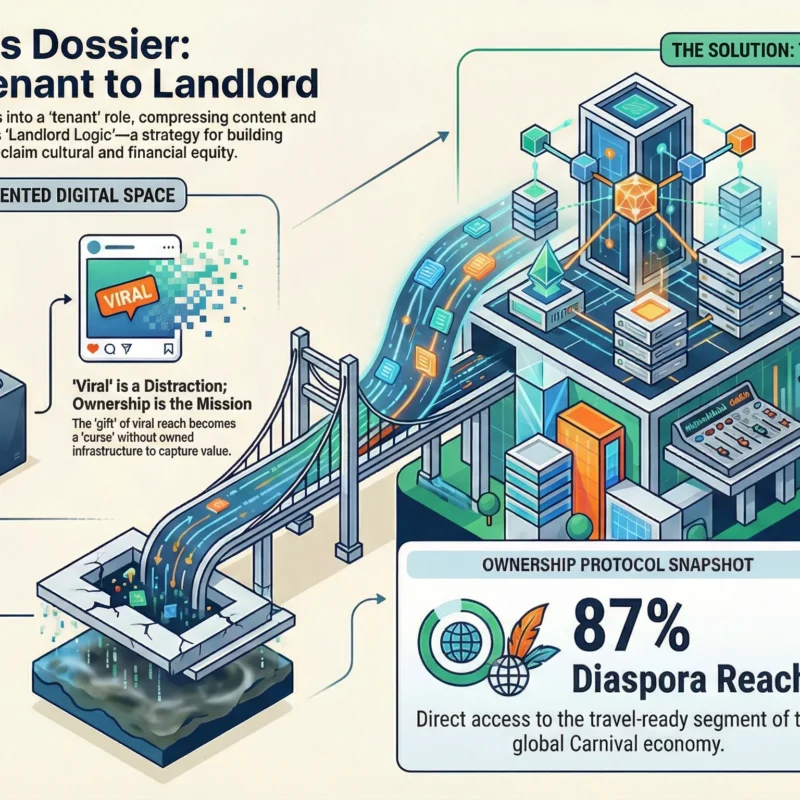
Carnival Radio serves as a vital infrastructure for cultural sovereignty, permanently archiving and projecting the legacy of Caribbean music into the global media ecosystem. By bypassing traditional institutional gatekeepers, it secures uninterrupted visibility for the diaspora.
Its systemic deployment across pervasive consumer endpoints—including voice automation via Alexa, home entertainment frameworks via TV (the Turner app and TuneIn), mobile dashboards in connected cars, and immediate browser availability via its dedicated Chrome extension—ensures that the acoustic heritage of Carnival is universally accessible. This continuous architectural presence counters systemic streaming erasure, anchoring Caribbean identity into daily global media consumption.