The Philosophy of the Signal: The Blueprint of a Movement
From Digital Sharecropper to Digital Landlord
Deploy the high-fidelity narrative. Stream the complete master case study directly via the YouTube Music matrix.
Initialize Audio
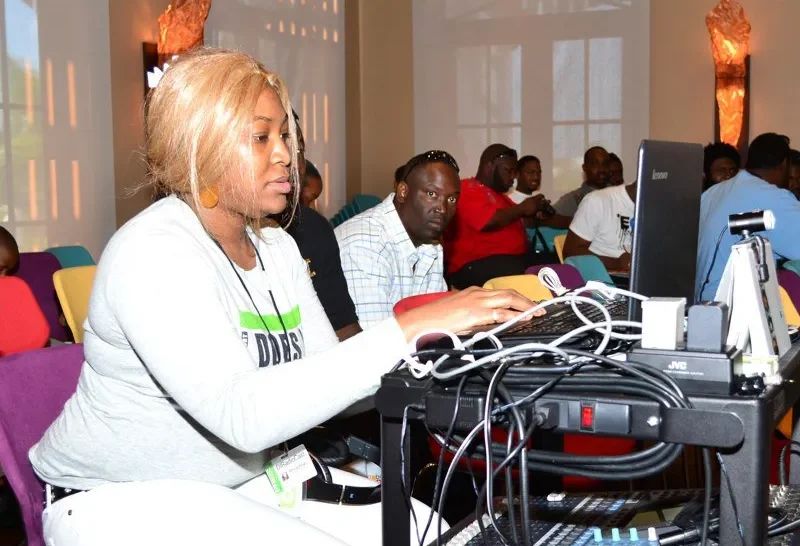
The history of Caribbean media is traditionally told through the lens of creative talent—the DJs, the artists, and the vibrant sound systems that captured global attention. However, a deeper structural evolution has been taking place behind the scenes. This historical review traces the 30-year migration of Caribbean media from legacy, geographic-bound analog radio towers to independent, decentralized digital networks. By analyzing the journey of Africa Allah—evolving from “The Mixtress” blending analog tracks to “The Architect” engineering sovereign digital soil—we can map how raw cultural capital has been systematically translated into technical and institutional authority.
The transition from legacy broadcast to digital sovereignty is predicated on Signal Path Mastery. In the traditional paradigm, media authority was tethered to physical geography—constrained by the wattage of a transmitter and the terrestrial limits of an island. The contemporary “Systems Architect” recognizes that authority has migrated from land-based licenses to the mastery of the digital path. The core objective is the delivery of a “Clean Signal”—an uncompromised, high-fidelity connection between the cultural source and the global diaspora.
The Architect’s Analogy: “Think of a Node like a digital lighthouse. In the old world, you had one big tower in one city. In our world, every listener, every NFC-enabled MusicalBead, and every high-fidelity stream is a ‘Node’—a connection point that makes our network stronger and harder to switch off.”
This architecture is explicitly engineered to defeat two primary systemic threats:
- Digital Sludge: Algorithmic noise that flattens culture, rendering unique Caribbean frequencies into generic, compressed content.
- Platform Compression: Third-party ecosystems that use AI filters and shadow-bans to misidentify cultural expressions, while simultaneously degrading the sonic integrity of the intellectual property (IP).
Sovereignty necessitates a permanent transition from “Rented Land” to “Owned Soil.” This philosophical pivot ensures that cultural assets are no longer vulnerable to the “Erasure Point philosophy” of external platforms. It is a decisive shift from operating as a tenant on rented platforms to becoming an independent digital landlord.
The Strategic Shift: Legacy Logic vs. Digital Landlordism
To understand this leap, one must first analyze the structural baseline. The transition over the last three decades represents a foundational shift in how cultural intellectual property is hosted, distributed, and owned:
| Structural Feature | Legacy Media Logic (1990s–2010s) | Sovereign Infrastructure (2025–2026) |
| Operational Reach | Geographic licenses & localized physical broadcast towers. | Global decentralized nodes bypassing physical borders (London, NY, Toronto). |
| Acoustic Quality | Compressed audio data resulting in algorithmic “Digital Sludge”. | Lossless, uncompressed High-Fidelity formats (320kbps master signals). |
| Ecosystem Ownership | Rented land on third-party social media and corporate distribution platforms. | Owned Soil hosted on proprietary, independent media servers. |
| Distribution Logic | Static, gatekept playlists dependent on centralized corporate approval. | Dynamic, automated networks protected by the “Ownership Protocol”. |
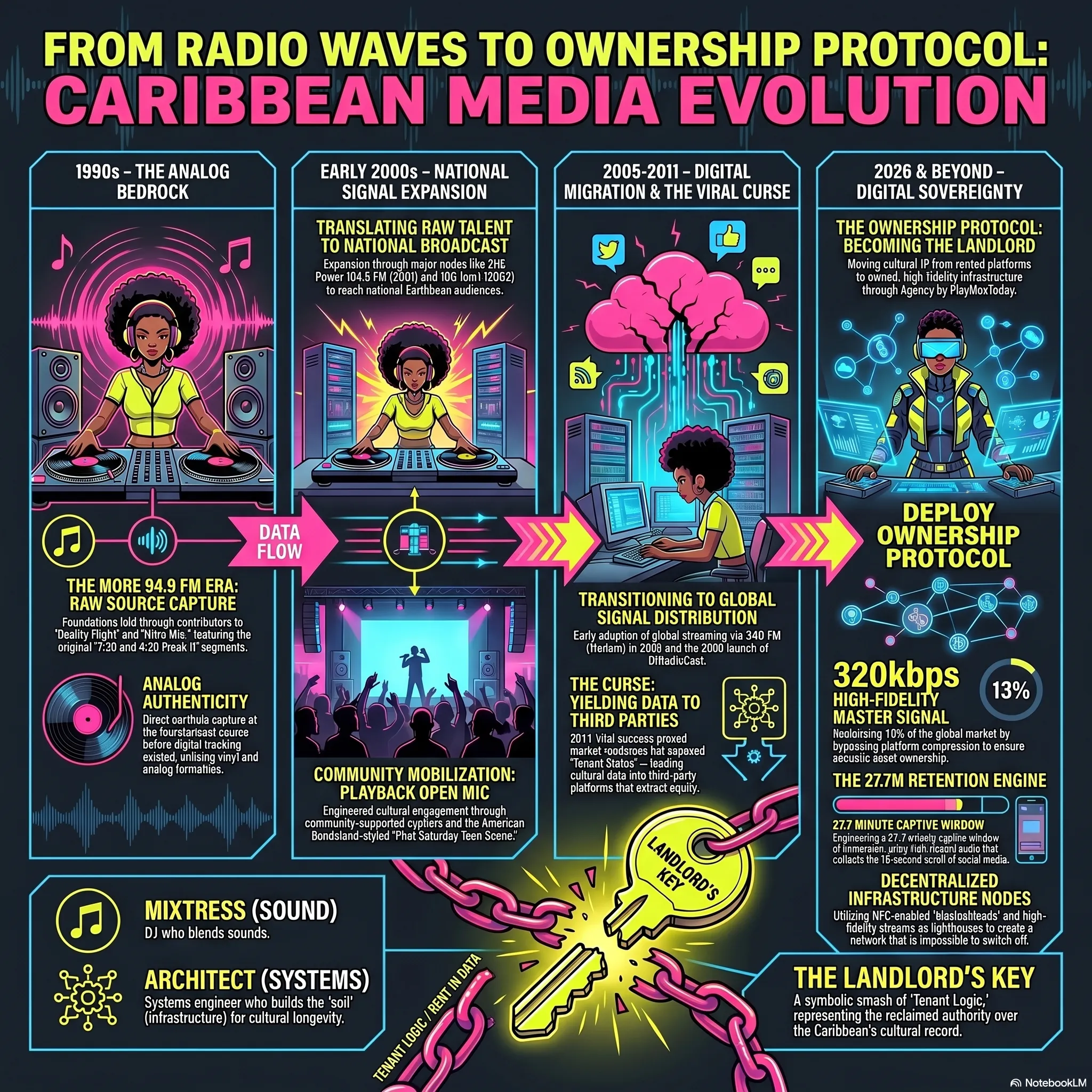
Era 1: The 1990s Analog Bedrock & Source Indexing
The evolution began with “direct earhole capture” at foundational Caribbean broadcast nodes. In the 1990s, the foundational infrastructure of Caribbean broadcasting was built on physical radio waves, notably localized at More 94.9 FM in Nassau. These entities provided the raw cultural material and localized credibility required to build the future technological bridge.
Foundational System Impact
Contributing to legendary broadcast segments like Reality Flight and Nitro Mix, Africa Allah introduced the highly influential “7:30 and 4:30 Freak It” segments, establishing foundational frequency dominance.
The Preservation Value
Before the advent of digital tracking, automated data indexing, metadata, or online cloud servers, this era required capturing live cultural expression directly at the source on physical analog tape. This process functioned as a critical mechanism for cultural de-risking. By securing “earhole” loyalty in a pre-algorithmic environment, media architects established the cultural frequency necessary to eventually bridge local broadcast success into a globalized digital distribution network. This act effectively cataloged the raw “Sonic DNA” of the Caribbean before it could be sanitized, altered, or erased by corporate gatekeepers:
- Rake n Scrape & Junkanoo: The rhythmic infrastructure of the Bahamas—these are the “Root” frequencies that maintain cultural stability in global urban spaces.
- Street Culture: The unfiltered, raw intensity of the neighborhood, secured as a primary brand asset.
- Early Soca & Hip-Hop: The crossover point where regional heritage met urban industrial precision.
Era 2: The Early 2000s National Scaling & Community Cyphers
The early 2000s marked a deliberate scaling of the physical media footprint across the region. This period saw the introduction of the PlayBack Open Mic cypher platform, managed under TAV Ent—a collaborative partnership between Reality, Tava, and Al. Designed for immediate community engagement, the platform optimized “earhole capture” by documenting raw talent at its cultural origin.
As “The Mixtress,” Allah was already identifying the massive scale of the diaspora. She wasn’t just playing tracks; she was operating as a co-host, contributor, and correspondent across the most vital nodes in the region, including the B-Team DJs Coalition. She was witnessing the transition from state-controlled broadcast to the first wave of private infrastructure.
Legacy Broadcast Node Matrix
These local nodes provided the foundational data that would eventually fuel a national expansion, moving from the neighborhood block to national airwaves:
| Era/Year | Node (Station/Entity) | Infrastructure Contribution / System Impact |
| 1990s | More 94.9 FM | Signal Origination: Contributor to Reality Flight and Nitro Mix; Creator of “7:30 and 4:30 Freak It” segments. First private FM radio station in the Bahamas. |
| 2001–2002 | ZNS Power 104.5 FM | National Uplink: Co-host of Phat Saturday. Utilized state-owned national broadcast channels to scale signal reach across the archipelago. |
| 2003 | 100 Jamz | Private Sector Integration: Phat Saturday Correspondent. Leveraged the first private radio infrastructure in the Bahamas to bypass state-run limitations. |
| Early 2000s | TAV Ent | Independent Community Node: Founding partner. Engineered a localized platform for community energy and raw talent mobilization. |
But the signal was about to face its greatest challenge: the move from national towers to the lawless digital frontier.
Era 3: 2005–2011 Digital Migration & “The Viral Curse”
The mid-2000s catalyzed the migration from FM airwaves to global streaming servers, initiating the era of the decentralized global signal.
- Early Adoption (2005): The integration of global streaming servers via SAR FM in Harlem, NY (via South African Radio) marked the first major digital era transition, adopting streaming servers to target the diaspora directly.
- Decentralized Infrastructure (2006): The strategic launch of DIRadioCast established an independent global distribution pipeline tailored for Caribbean digital content.
- Viral Propagation (2011): This phase served as a beta test for decentralized audience mobilization. It proved the market readiness for high-fidelity signal shifts and demonstrated the architect’s ability to move mass audiences through digital execution.
The Structural Trap
Despite achieving millions of views and massive algorithmic reach, this period exposed a profound structural flaw labeled “The Viral Curse.” While viral reach provided massive visibility, it exposed the vulnerability of platform dependency.
The Gift vs. The Curse: “Viral is a distraction; Ownership is the mission. When you generate millions of views on rented land (social media), you are a tenant. You are building equity for the platform, not the culture. To survive, you must move from the feed to the soil.”
Relying entirely on compressed, third-party corporate platforms meant that independent creators were effectively paying “rent” with their own cultural data. The hosting networks extracted the permanent enterprise value and metadata equity, while the creators remained exposed to algorithmic suppression, shadow-bans, and volatile shifts in corporate terms of service. This realization established the “Owned Soil Strategy”: Social media is a tool for the feed, but proprietary infrastructure is for the archive. The mission shifted from viral distraction to institutional engineering.
Era 4: 2025–2026 The Ownership Protocol & Digital Landlord Logic
To counteract this systemic data extraction, the modern era has seen a complete pivot away from “digital sludge”—that algorithmic noise and platform compression that flattens cultural nuances. As of 2025 and 2026, the operational command has migrated to the “Ownership Protocol” managed under the structural authority of Agency by PlayMasToday. Africa Allah stepped completely into the role of The Architect, shifting the core focus from chasing superficial online metrics to building sovereign, institutional-grade media networks.
                         THE OWNERSHIP PROTOCOL

      [Cultural DNA Asset] ---> [320kbps Master Signal] ---> [Decentralized Nodes]
               |                                                      |
      (B2B-Ready Brand)                                      (Sovereign Soil)
The Architecture of Equity Nodes
The 2026 deployment of the Ownership Protocol secures, de-risks, and sanitizes the diaspora’s media assets through three core nodes of equity:
- The Narrative Node: Preserves historical continuity and protects authentic cultural records through the Architect’s Dossier (retaining an institutional record of strategy and an 87% Diaspora Reach to the “travel-ready” segment) and unfiltered, sovereign broadcast paths.
- The Acoustic Node: Guards auditory assets from third-party compression by delivering a “Clean Signal” over a 320kbps High-Fidelity Archive consisting of over 1,000 episodes of curated mixes. This is reinforced by The Pull Up Party Standard—a strict 90-day evergreen rotation policy where no track is repeated within a three-month window, ensuring a fresh, non-redundant auditory experience.
- The Equity Node: Encrypts and locks cultural heritage into a protected digital asset class using The DNA Vault and independent infrastructure managed by Agency by PlayMasToday, which acts as the definitive mechanism for ownership transfer and B2B brand engineering.
This systemic overhaul targets the immediate closure of “The Skin Gap”—the historical technological disparity in advanced media tools available to Caribbean creators. By upgrading these operational standards, the protocol creates an engineered pathway to reclaim an estimated 13% of global market share back to the diaspora.
Technical Authority: Fidelity as a Trust Signal
In the 2026 standard, technical specifications are the primary gatekeepers of authority. Quality is not a luxury; it is a trust signal for the sophisticated diaspora listener.
- 320kbps Audio Standard: A baseline requirement for digital equity. This standard actively reclaims market share from compressed platforms, ensuring that the essential bass depth and lyric clarity of Caribbean music are never compromised by platform “sludge.”
- The 27.7M Retention Engine: While social platforms compete for volatile 15-second intervals, this engine targets a 27.7-minute conversion window. This is “Neuro-fidelity”—a physiological “lock-in” effect achieved by bypassing platform compression to provide deep, acoustic immersion that outlasts the scroll.
- The DNA Vault & NFC-enabled MusicalBeads: Serving as the physical-digital “Ownership Anchor,” these beads act as the encrypted bridge between the listener and the sovereign signal, turning cultural participation into verifiable asset ownership.
Without these rigorous technical benchmarks, cultural IP remains highly susceptible to algorithmic flattening. High-fidelity validates the Sovereign DJ as the primary broadcaster and gatekeeper of the cultural archive.
Conclusion: The Sovereign Digital Landscape
The multi-decade trajectory from a 1990s radio contributor at More 94.9 FM to a 2026 Media Architect is the definitive case study for Institutional Engineering. It marks the transition from simply being “early to market” to becoming “The Market Infrastructure” itself.
Key Architectural Takeaways
- Owned Soil vs. Rented Land: True sovereignty requires proprietary ecosystems—including owned media servers, custom code bases, and physical NFC anchors—to permanently protect cultural assets from algorithmic erasure and platform manipulation.
- Neuro-fidelity as Lock-in: Audience retention is the modern currency of power. Uncompressed high-fidelity audio functions as a physiological tool for deep behavioral capture, achieving a stable 27.7-minute engagement window.
- The Physical-Digital Bridge: The NFC-enabled MusicalBead stands as the 2026 standard for locking down transient cultural heritage into a secure, verifiable digital asset class.
The mandate for the global Urban-Caribbean diaspora is absolute: “The boundary is the signal, not the land.” Geography is no longer a constraint; the strength, ownership, and routing of the signal path is the only true metric of future power.
Access gets you into the building. Authority owns the deed.