
Discover Music Channel // File: InsidetheFestivalTalkVol 2_03
Subject:
EPISODE ABSTRACT
Guest: Jerome Smith (Sideline Bahamas) Host: Africa Allah
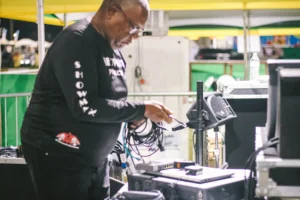
How does a festival evolve from a visual spectacle into a meaningful cultural dialogue? I
How does a festival evolve from a visual spectacle into a meaningful cultural dialogue? In this installment of Inside the Festival, Africa Allah and Jerome Smith of Sideline Bahamas dissect the transition of their platform from a video-focused documentary series to an audio-driven exploration of the Caribbean’s creative economy.
Strategic Assessment: The Commerce-vs-Culture Paradigm in Bahamian Festival Management
Strategic Assessment: The Commerce-vs-Culture Paradigm in Bahamian Festival Management
1. Evolution of the Funding Model: From State Mandate to Privatization
Writing from the vantage point of 2026, it is clear that the Bahamas Carnival has undergone a fundamental structural metamorphosis since its 2015 inception. What began as a government-pumped initiative, buoyed by massive subsidies and state-led marketing, has transitioned into a strictly privatized framework. This evolution was not merely a change in accounting; it necessitated a psychological shift from government dependence to “entrepreneurial risk,” demanding that promoters operate with a market-driven discipline that was absent in the era of state safety nets.
The contrast in market behavior between the 2015 launch and the 2026 landscape is stark. In the early years, the government’s concerted marketing effort created a high-visibility environment, yet as of 2026, participation has plummeted to a critical threshold—approximately one-third of the original 2015 baseline. This decline signals that privatization is not a passive state but an active requirement for business-savvy management; without the government’s cushion, promoters are forced to use their limited capital with lethal strategic precision to avoid market obsolescence. The survival of the festival now rests on its ability to function as a self-sustaining commercial product rather than a subsidized cultural hobby. This fiscal reality dictates that the entire festival must be managed as a rigorous economic engine, fueled by a sophisticated ecosystem of stakeholders.
2. The Carnival Ecosystem: Mapping Economic Interdependencies
To appreciate the sustainability of the Bahamas Carnival, one must look past the feathers and music to see a high-velocity value chain. This “engine room” is an interconnected network where the success of a single parade drives revenue across multiple sectors, making Carnival a vital catalyst for national economic liquidity.
The key entities within this ecosystem include:
- Junkanoo Artisans: The design and construction specialists who translate cultural motifs into commercial costumes.
- DJs and Musical Talent: The acoustic architects responsible for the festival’s primary “vibe” and international appeal.
- Sound, Lighting, and Staging Technicians: The technical backbone required for large-scale immersive events.
- Transportation Providers: Taxi drivers and car rental agencies who facilitate the movement of high-spending international guests.
- The Hospitality Sector: Hoteliers and guest house operators who convert festival interest into “heads in beds.”
- Food and Beverage Vendors: Local entrepreneurs who leverage the road march as a high-traffic retail environment.
The strategic significance of this ecosystem lies in its role as a secondary revenue stream for traditional culture; Carnival revenue allows Junkanoo artisans to reinvest in their non-commercial, traditional products for the Boxing Day and New Year’s parades—events for which they are otherwise largely unpaid. Furthermore, Carnival serves as the “perfect commercial” for domestic brands like Sands, Kalik, and Blue Water. When international revelers are captured on the road enjoying a Sands beer or crisp Blue Water, it creates a powerful brand association that drives export potential and local pride simultaneously. This economic synergy ensures that the festival’s commercial success directly subsidizes the preservation of the nation’s foundational cultural traditions.
3. Culture vs. Commerce: Negotiating Authenticity and Growth
The introduction of Carnival in 2014 triggered an intense strategic anxiety, characterized by the “2014 fear” that this foreign format would surpass or dilute Junkanoo within five years. This tension remains a critical consideration for national identity, as the festival’s growth depends on its ability to be seen not as a threat to tradition, but as an extension of it. The market now distinguishes between three cultural products: Performative (the spectacle-focused model of Junkanoo or Brazil), Immersive (the participant-driven Trinidadian model), and Formative (the foundational heritage of the people).
The “2025 Breakthrough” remains the pinnacle of this negotiation, where goat-skin drums—the literal heartbeat of Junkanoo—were finally and intentionally infused into the Carnival road march. This was not a mere musical addition; it was a reconciliation of “Formative” Bahamian soul within an “Immersive” commercial format. By finally “Bahamianizing” the road march after a decade of experimentation, the festival proved it could house authentic cultural elements without losing its global commercial edge. This successful integration has neutralized the fear of cultural dilution, repositioning Carnival as a vessel for Bahamian identity rather than a replacement for it.
4. Strategic Marketing: International Tourism vs. Local Participation
There is a sharp distinction between an “entertainment product” for local consumption and an “entertainment tourism product” designed to move the national GDP. To maximize economic impact, the Bahamas must move beyond “piggyback” marketing—the lazy reliance on tourists who happen to be on the island—and commit to direct marketing that specifically targets the international “heads in beds” demographic.
While the industry has shifted from physical costume launches to digital reveals for global reach, this transition carries a high risk of brand sterility. Digital marketing can reach the world, but if it lacks the visible, local “vibe” and the infectious euphoria of Bahamians participating in their own culture, it fails to validate the product for international travelers. Tourists do not travel for costumes alone; they travel for the authentic experience of a people in celebration. Therefore, marketing strategies must ensure that the local excitement remains high, as local participation is the primary credibility marker for the global tourism market. This authenticity is best preserved and communicated through the strategic sovereignty of media and documentation.
5. Media Sovereignty and the Value of Cultural Archiving
Documentation is more than a recap; it is a strategic asset and a blueprint for future growth. To secure high-level international corporate sponsorship, the Bahamian festival media must pivot away from hyper-sexualization and toward the capture of “euphoria” and “storyline.” Corporate entities shy away from products that appear exploitative, but they will aggressively invest in a brand that showcases joy, cultural depth, and the creative talent behind the scenes.
The value of cultural archives cannot be overstated, particularly those featuring legendary figures like the late “Blacks” and Ricardo Drew. These archives serve three critical functions:
- They provide an Operational Blueprint, allowing current promoters to see what worked in previous seasons without “rewriting the script” every year.
- They maintain Cultural Sovereignty, ensuring that the Bahamian story is told by Bahamians, not external observers.
- They build Brand Heritage, giving the festival a sense of history and gravitas that attracts long-term investment.
By prioritizing media sovereignty, the Bahamas ensures that the story of its festivals—its triumphs, its losses, and its evolution—remains a national asset rather than a fleeting digital moment. This archive is the foundation upon which a year-round cultural economy can be built.
6. Conclusion: Toward a Sustainable Festival Calendar
The future of Bahamian festival management is encapsulated in the “Franklin Wilson Vision”: a year-round, strategic calendar comprising a Winter Festival (Junkanoo), a Spring Festival (Carnival), and a Summer Festival (Goombay/Junkanoo Summer Festival). This 360-degree approach ensures that the creative industry is never “out of season,” providing consistent economic opportunities for artisans, DJs, and vendors.
To secure this future, two success factors are non-negotiable: the product must be priced to ensure community inclusion while strategically “pricing out the riff-raff” to maintain the safety and sanctity of the curated space, and the Bahamas must maintain “Landlord” status over its cultural space. Being the landlord means the nation owns the architecture of the festival and is never beholden to external agendas or watered-down corporate mandates. The Bahamas is far more than a “sun, sand, and sea” destination; it is a cultural powerhouse that, through business-savvy management, can dominate the global market by asserting its own unique cultural sovereignty.
The Breakdown:
- The Pivot: Why the “Talk” format was necessary to address the complex relationship between cultural identity and commercial viability.
- The Archive: A look at how a decade of documentation has turned into a vital historical record for Bahamian artists and organizers.
- The Product: The strategic necessity of integrating Junkanoo and local flavor to maintain a “distinct tourism product” in a sea of global carnivals.
- The Reality Check: A candid discussion on privatization, the risks of hypersexualization in media, and the “hole” in the current market that needs filling.
A retrospective on a decade of cultural preservation and a call to action for sustainable growth within the regional festival landscape.
FAQ
Q: What is the main difference between ITF Video and ITF Talk? A: While our video series captures the high-energy euphoria of the road, ITF Talk focuses on the “engine room”—the logistics, strategic marketing, and cultural preservation that allow the festival to function and grow.
Q: How does Carnival support traditional Junkanoo? A: Contrary to the “Culture vs. Commerce” debate, Carnival provides a commercial platform for Junkanoo artisans to earn a living from their craft, which they then reinvest into their traditional, non-profit Junkanoo projects.
Q: Why was the 2025 Road March a milestone for the brand? A: 2025 marked the first time in a decade that authentic Junkanoo goat-skin drums were integrated into the Carnival road march, successfully blending deep-rooted Bahamian heritage with a modern international festival.