What Do a DJ, an Author, and a Stage Manager Have in Common?
If you looked at my resume, you’d probably see a few different people. There’s the guy who has managed massive destination events across the Caribbean, New York, and Atlanta. There’s the license holder for a community radio platform. There’s the founder of a digital agency. And yes, there’s also the DJ, the author, and the web developer.
This might look like a scattered career, but after three decades, I’ve realized I only ever had one job: I am the glue.
My professional life isn’t a collection of separate streams; it’s one singular, powerful ecosystem. In today’s fast-moving media landscape, success isn’t about being the absolute best at one thing; it’s about being the vital connection that ensures every moving part—from the stage lights to the social media feed—works together seamlessly.
Defining the Ecosystem
The problem I constantly saw, and the reason I built my agency this way, is what I call Silo Syndrome.
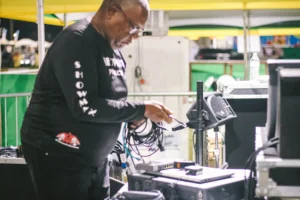
In most businesses, production doesn’t talk to communications. The A/V team doesn’t check in with the web design team. This results in beautiful, expensive components that don’t fit together, leading to friction, wasted time, and a jarring experience for the audience.
My approach is simple: Your brand should be a high-performance ecosystem. This means I don’t just multi-task; I integrate. I use the logistical rigor of a stage manager to structure a website’s user experience (UX), and I use the pacing knowledge of a radio producer to script a corporate video. The goal is a unified message, delivered flawlessly across every channel.
The Foundation of Authority: 30 Years of Practice
This concept isn’t theory; it’s the result of three decades in the trenches. It is this unique, comprehensive view of communications—from the physical event logistics to the digital payload—that allowed me to found Agency by playmastoday and serve as the license holder for a platform like Carnival Radio.
When a client hires my agency, they aren’t just getting a vendor; they’re getting an operational framework proven to handle the high-stakes, cross-cultural complexity of global destination events. This lived experience is the foundation of my authority. I know how to handle the inevitable chaos because I’ve been the one holding the microphone, running the board, and deploying the website all at once.
Case Study: The Broken Silo
Early in my career, I worked on a major corporate event where the digital team designed a fantastic interactive survey for attendees. The stage manager, however, decided to run a last-minute video presentation that unexpectedly pushed the schedule back by 15 minutes.
The result? The entire audience missed the call-to-action for the survey, the digital team’s metrics failed, and the client was frustrated because their investment in technology yielded zero results.
This single instance of a broken communications silo taught me that the best design is useless without logistical mastery. Since then, I’ve built a career on being the person who ensures the person behind the camera knows what the person behind the podium is doing, and that both actions align perfectly with the message being pushed to the attendees’ phones. That is the true value of the “glue.”
The Reflective Conclusion: Building Your Own Framework
If you feel like you have a “scattered” work history, stop seeing it as a weakness. See it as an emerging framework. The market today desperately needs people who can translate between highly specialized worlds. Your career isn’t a random collection of roles; it’s a powerful operational framework waiting to be deployed.
In the next post, I break down the five essential, tactical skills you learn only by managing both the stage and the server room—the true toolkit of the Ecosystem Architect.
What two seemingly opposite skills do you rely on most in your career?