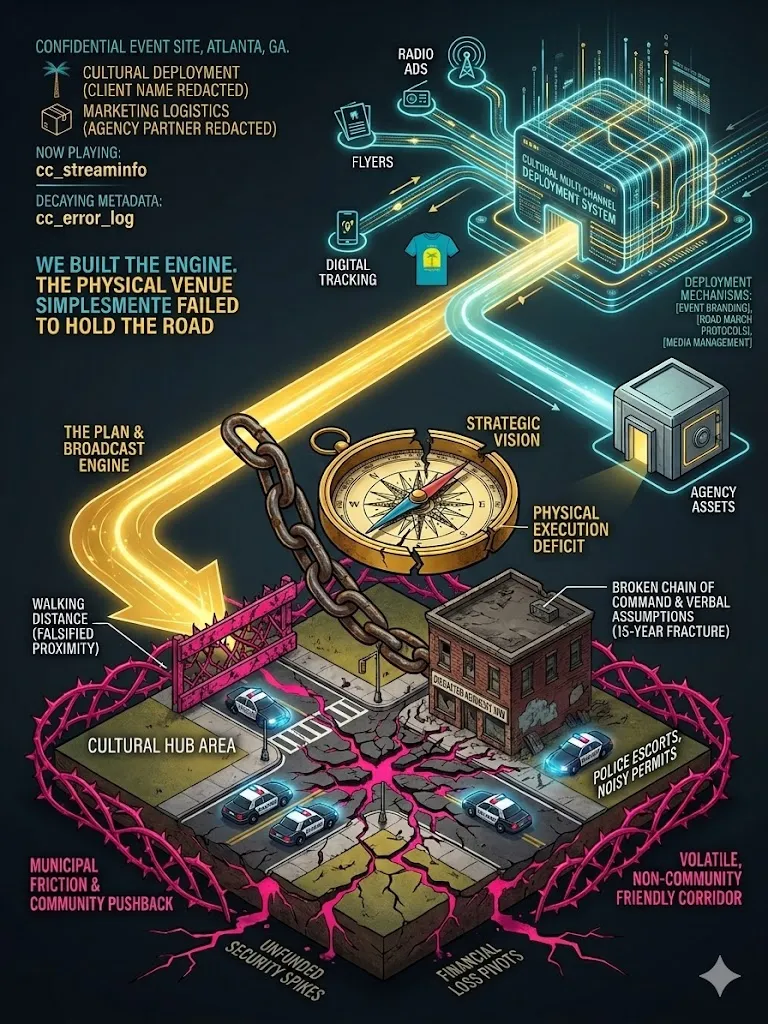
Moving forward, the Agency by PlayMasToday must enforce a strict policy: no marketing, sound brokerage, or talent assets will be deployed without written, signed contracts that establish a transparent chain of command and verify all municipal permits in advance. We built the engine; the physical venue simply failed to hold the road.
On the surface, executing a cultural gathering appears beautifully simple—a straightforward arrangement of people, rhythms, and community celebration. This surface narrative is the ultimate trap of creative production. In reality, launching an open-air public event within a highly regulated urban commerce center requires navigating a dense maze of municipal permits, civil liabilities, law enforcement constraints, and strict noise and decency regulations. When those hidden elements are mishandled on the ground, even the most brilliant marketing engine cannot save a compromised physical environment.
1. The Surface Illusion vs. Complex Reality
To understand the true value of cultural marketing and event production, one must look directly at the hidden logistics required to keep the public safe and compliant. Organizing a public experience is an exercise in strict risk management. It requires local permits, police escorts, absolute adherence to neighborhood noise pollution caps, and zero-tolerance policies regarding explicit content to comply with regional ordinances.
When an agency is hired to build the infrastructure of an event, its work covers two completely different realms: the visible marketing engine and the invisible on-site execution ledger. When the on-site execution fails due to partner incapacity, the entire project faces sudden and severe operational friction.
2. The Anatomy of Deployed Value and Hidden Scope
In a recent cultural campaign, the Agency was tasked with executing the core structural pillars: multi-channel marketing, sound brokerage, and talent liaison management. The agency built a high-value marketing system that achieved total market penetration, deploying 5,000 physical print flyers alongside synchronized radio ad campaigns, digital player engines, and morning show host liners. This campaign was completely built on the commercial promise of convenience, safety, and geographical proximity to a primary public parade route.
However, the physical execution fell completely flat due to operational failures on the ground that completely contradicted what was promised during planning:
- Geographic Disconnection: The venue selected by on-site stakeholders was completely outside of practical walking distance from the main route, immediately breaking the consumer convenience loop and alienating high-intent attendees.
- Volatile Environment Hazards: The event was housed adjacent to a volatile, high-crime corridor that was fundamentally non-community-friendly. This critical flaw instantly compromised public safety and drove away buyers who prioritized personal security.
- Unfunded Operational Spikes: Because of the volatile location and a failure by local partners to secure necessary municipal permits, the project suffered intense neighborhood pushback, requiring a massive, emergency spike in security personnel that shattered original budget allocations.
3. The Breaking Point: When Bad Business Destroys Longstanding Ties
The tragedy of this project did not lie in a failure to capture public attention; it lay in a broken chain of internal communication and a total lack of formalized, written business protections. The true scope of the physical limitations was hidden and downplayed by individuals who simply did not possess the financial, professional, or logistical capacity to manage a public undertaking of this magnitude. Decisions were made based on verbal assumptions rather than signed, binding B2B contracts.
An Urgent Operational Truth: It is a painful but necessary reality of this industry that friends are often destroyed by bad business. This project ultimately fractured a 15-year relationship as a direct result of jeopardizing the safety, credibility, and operational security of the Agency by PlayMasToday, its staff, its vendors, and its contracted talent.
When a partner avoids clear accountability, cuts operational corners, and fails to deliver basic municipal clearances, they do not just compromise a party—they expose an entire organization to severe legal, financial, and physical danger.
4. Defining the Boundary of Agency Accountability
To preserve professional integrity, a firm line must be drawn between marketing delivery and local venue execution. An agency’s obligation ends where the physical execution failures of independent partners begin. The following matrix outlines the operational realities of this deployment:
| Operational Pillar | Agency Status | Execution Ledger Reality |
| Multi-Channel Marketing | ✔️ FULLY EXECUTED | Saturated market with 5,000 print flyers, radio ad rotations, and automated digital tracking systems. |
| Sound Brokerage & Logistics | ✔️ FULLY EXECUTED | Procured high-grade audio systems and mobile stage assets on schedule. |
| Talent Liaison & Booking | ✔️ FULLY EXECUTED | Contracted and managed high-profile artists and DJs, enforcing strict lyric decency compliance. |
| Municipal Permitting | ❌ PARTNER FAILURE | On-site stakeholders failed to secure city permits, triggering community pushback. |
| Venue Safety & Proximity | ❌ PARTNER FAILURE | Selected an unsafe, non-walkable, high-crime location that violated marketing promises. |
5. Building Permanent Equity via Media Syndication
The most important lesson for any creative organization is understanding where the true value resides when an event suffers a financial loss. The Agency did not just organize a transient event; it built a sophisticated media syndication pipeline under its core broadcast brand, CarnivalRadio.Live. This platform successfully transformed temporary entertainment into permanent promotional assets, delivering massive commercial value.
The custom radio spots, custom-engineered digital web players featuring live metadata scripts, branded apparel designs, and syndicated audio mixes are not temporary marketing materials. They are long-term, high-value intellectual property. While the physical event was completely undercut by a broken venue, the media infrastructure remains an asset that can be cleanly packaged, monetized, and deployed again in an optimized environment.
When an event suffers financial losses due to operational failures on the ground, the only remaining value is the Intellectual Property and Media Equity created by the Agency. The Agency successfully built a high-value marketing system that can be deployed again in a different location.
Frequently Asked Questions
What is the real value of cultural marketing and media management?
The real value lies in building permanent brand equity. While physical events are temporary, the custom media syndication pipeline—including radio spots, syndicated mixes, branded apparel designs, and custom web player code—remains high-value intellectual property that can be redeployed, scaled, or monetized for future activations.
Why do digital ticket sales sometimes lag for major cultural events?
Urban and cultural demographics frequently operate on a high-touch, community-first model. Consumers place a premium on physical validation, word-of-mouth trust, and on-site pop-up interactions. Because of this localized behavior, high-intent buyers often favor direct, physical transactions over immediate online checkout pipelines.
Where do an entertainment agency’s contractual obligations end?
An agency’s responsibility covers its contracted deliverables, such as multi-channel marketing, talent booking, and sound brokerage. Accountability stops at the physical venue line. Local venue partners and stakeholders are strictly responsible for municipal permitting, choosing a safe, community-friendly location, and on-site logistics execution.
What hidden complexities exist when planning open-air public events?
Public events in busy commercial corridors require rigorous regulatory compliance. Organizers must secure strict local municipal permits, coordinate with off-duty police details for crowd control, establish safety boundaries, and strictly adhere to local noise pollution and public decency ordinances, including lyric monitoring.
Why are written B2B contracts critical for collaborative events?
Relying on verbal agreements or loose understandings can shatter the chain of communication and hide the real scope of a project. Formal, written B2B contracts clearly establish the chain of command, protect vendor safety, secure institutional credibility, and prevent financial loss when one party fails to execute their duties.