The Digital Modernization of a 20-Year Legacy Brand
Project Overview In the high-stakes environment of Nassau’s destination event industry, a legacy brand celebrating its 20th anniversary faced a critical crossroad: its digital presence was fragmented, dependent on third-party social silos, and lacked a secure, owned infrastructure for commerce. This case study details the 90-day transformation of the brand’s identity from a social-media-reliant entity into a self-governing, data-driven institution.
The Challenge: Infrastructure vs. Impression The project launched with a significant technical deficit. While the brand owned its domain for three years, it lacked hosting, leaving it vulnerable to data loss and “invisible” to search engines. Initial stakeholder interactions revealed a disconnect between the “front-end” desire for immediate visual gratification and the “back-end” necessity of building a secure, SEO-optimized, and fraud-resistant commerce engine.
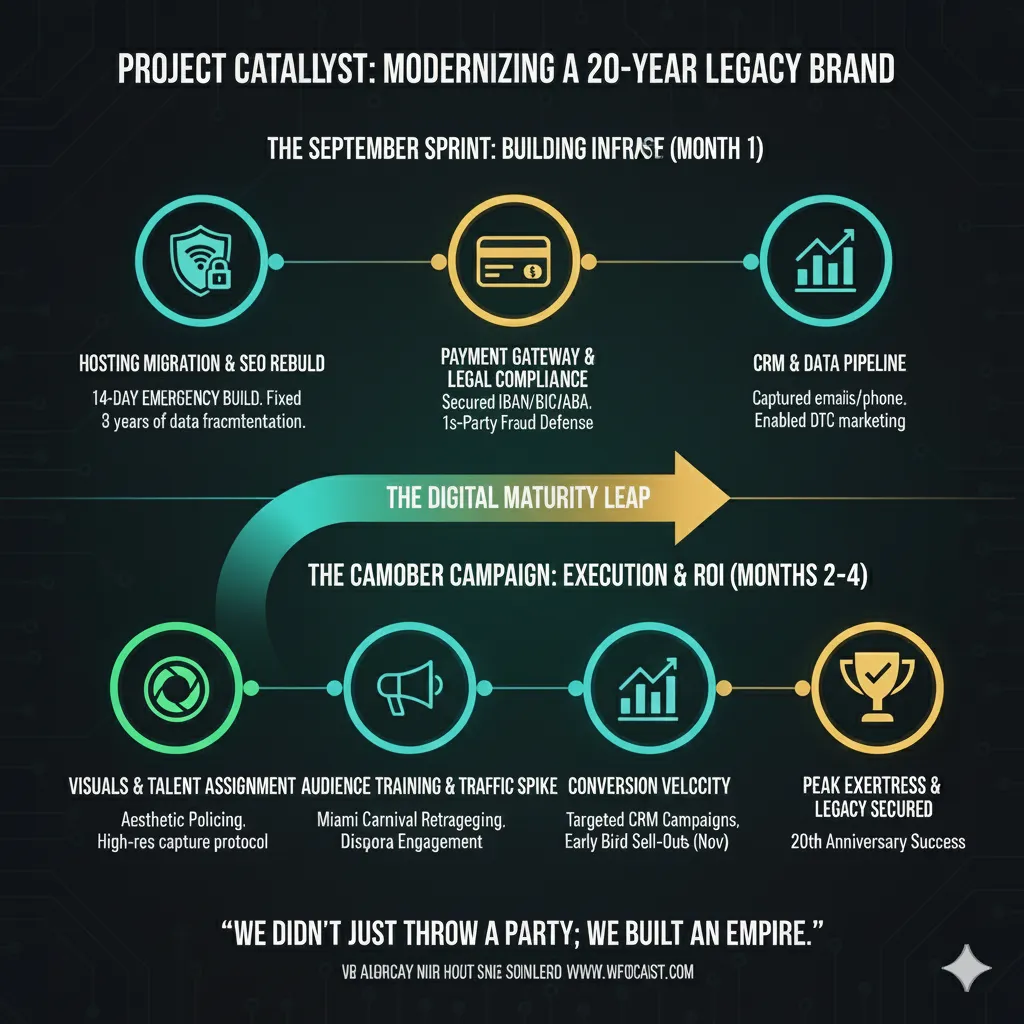
Strategic Intervention Over a 14-day “September Sprint,” the project’s scope expanded beyond marketing into Systems Architecture and Brand Governance:
- Infrastructure Sovereignty: Successfully migrated and rebuilt the brand’s digital home, integrating a direct-to-consumer (DTC) ticketing system and CRM to capture first-party data.
- Creative Sovereignty: Established professional boundaries by shifting client dynamics from “Micro-Management” to “Strategic Review,” ensuring the 20-year legacy was reflected in every high-resolution capture and stage assignment.
- Risk Mitigation: Navigated complex international banking compliance (IBAN/BIC/ABA) to implement a secure payment gateway, specifically designed to withstand the fraud attacks common to high-demand destination events.
Key Outcomes
- Market Expansion: Leveraged Meta ad data to successfully reach the Bahamian diaspora in the US and Canada, timing the campaign rollout to coincide with global cultural peaks like Miami Carnival.
- Business Intelligence: Identified a 25% attendance growth correlation tied to periodic venue changes, providing the client with a long-term strategic roadmap for future events.
- Operational Maturity: Verified the first successful automated transactions by November 1st, transitioning the brand from a manual, “cash-and-carry” mindset to a professionalized e-commerce model.
The 20th-anniversary campaign served as more than a celebration; it was a total digital audit and upgrade. By prioritizing infrastructure and fraud protection alongside visual storytelling, the brand did not just sell tickets—it secured its legacy for the next two decades.
Communications & Management — Navigating the “Messy Middle”
A brand is only as strong as the systems that manage it. In this project, the primary challenge wasn’t just creating a visual identity; it was managing the flow of information and the psychology of the stakeholders.
1. The WhatsApp “War Room”
In the Caribbean market, WhatsApp is the default headquarters. While this allows for rapid decision-making, it often creates a “noise” problem where unfinished work is critiqued as if it were the final product.
- The Strategy: I implemented a boundary between process and presentation. By educating the client on the “14-day production window,” I transformed the chat from a space of anxious micro-management into a high-level review board.
- The Insight: Professional management requires the courage to defend the production timeline against “instant” expectations. This transition allowed the creative team to focus on technical integrity rather than reactive adjustments.
2. Transitioning from “Service Provider” to “Strategic Partner”
A pivotal moment in this project was redefining the client-manager relationship. By asserting expertise over the technical infrastructure (SEO, hosting, and data security), the role shifted.
- The “Owner vs. Reviewer” Framework: I successfully guided the stakeholders to embrace their role as “Reviewers” of finished milestones. This reduced friction and allowed the brand’s 20th-anniversary vision to stay pure, rather than being diluted by “design-by-committee.”
- The Result: This shift in communication style paved the way for the stakeholders to trust the move into a $100\%$ digital commerce model, which was a significant cultural shift for the organization.
3. Training the Audience Through Storytelling
Communication wasn’t just internal; it was external. We used Meta’s ecosystem to “train” a legacy audience to use new tools.
The Outcome: This high-touch communication strategy decreased customer support inquiries and increased early-bird adoption, as the audience felt “guided” through the brand’s digital evolution.
The Method: We didn’t just post flyers; we shared the “why” behind the new website. By using interactive IG stories and WhatsApp status updates, we created a bridge for older, legacy fans to feel comfortable using the new digital ticketing platform.
“Great brand management is 30% creative execution and 70% communication management. You cannot build a premium brand if the stakeholders are operating in a ‘low-fidelity’ communication loop. Moving the conversation from ‘instant feedback’ to ‘strategic review’ is the single most important step in scaling a destination event.”
Industry Lesson
Production & Execution — Beyond the Digital Veneer
A premium brand identity is fragile; it can be built over months on Instagram and destroyed in seconds by a poorly managed stage presence. In this phase, my role shifted from Digital Architect to Production Director, ensuring that the physical event lived up to the 20-year legacy we sold online.
1. Visual Capture & Composition: Documenting the Legacy
In the world of destination events, the “after-movie” and social captures are as important as the event itself. They are the marketing assets for the following year.
- The Strategy: I didn’t just hire photographers; I managed visual composition. This involved assigning specific talent to specific “capture windows” to ensure the lighting, backdrop, and crowd energy matched the brand’s premium aesthetic.
- The Goal: To create “evergreen” assets. By directing the visual team to focus on the 20th-anniversary milestones, we ensured the content reflected a “once-in-a-lifetime” experience rather than just another party.
2. Aesthetic Policing: The “Stage Presence” Standard
One of the most critical aspects of this project was enforcing a standard of professionalism for everyone on the “front lines.”
- The Intervention: I challenged the status quo regarding the on-stage look. If the digital brand says “Legacy and Prestige,” the physical stage cannot look like a “children’s party.”
- The Implementation: We instituted strict dress codes and stage protocols for talent and staff. This ensured that every phone-camera video taken by an attendee—and subsequently posted to social media—served as a high-quality advertisement for the brand.
3. Talent Management as Brand Alignment
Talent assignments weren’t just about who could perform; they were about who fit the Brand Values.
- The Curation: I oversaw the selection of talent that resonated with both our “Legacy” audience and the new, younger demographic we were targeting.
- The Synergy: By aligning the talent’s personal brand with our event’s 20th-anniversary theme, we created a seamless experience where the artist and the event felt like a singular, high-end production.
4. Audience Experience Training
Execution also involves managing the “flow” of the attendee journey.
The Result: When the audience arrived, they weren’t just attendees; they were participants in a curated brand experience.
The Digital-to-Physical Handshake: We used our new CRM and communication channels to set expectations before guests even arrived in Nassau. From “Early Bird” perks to dress code announcements, we “trained” the audience to expect a higher level of production.
“Production is where the ‘promises’ made in marketing are kept. If your digital brand is ‘Premium,’ your physical execution cannot be ‘Casual.’ As a brand manager, you must have the authority to police the stage, the talent, and the visual captures, or you risk devaluing the entire campaign.”
Industry Lesson
Legal & Risk Management — Building the Revenue Fortress
In the destination event industry, a “sold out” event is a failure if 20% of the revenue is lost to fraud, chargebacks, or non-compliant banking structures. For this 20th-anniversary project, my role as Brand Manager included acting as a Risk Architect, moving the organization away from high-risk manual payments toward a secure, audited financial ecosystem.
1. Financial Compliance: The IBAN/BIC/ABA Battle
To transition the brand to a self-hosted ticketing model, we had to bridge the gap between local Bahamian banking and international e-commerce standards.
- The Challenge: Obtaining the necessary BIC, IBAN, and ABA routing information was not just a clerical task; it was a prerequisite for bank approval. Without these, the payment gateway could not be authorized.
- The Execution: I managed the “Test Page” protocol required by the bank, ensuring that every legal requirement—from refund policies to Terms of Service—was visible and compliant.
- The Value: By handling the “technical heavy lifting” of banking integration, I secured the brand’s ability to accept international payments directly, reducing their dependence on expensive third-party aggregators.
2. Fraud Mitigation & Attack Prevention
High-profile destination events are prime targets for bot attacks and stolen credit card usage.
- Proactive Defense: By owning the hosting and the payment gateway, we gained the ability to monitor transaction patterns in real-time. We implemented security layers that “plug-and-play” social media ticketing often lacks.
- Chargeback Protection: I ensured that the digital “paper trail”—from the moment a user clicked an ad to the moment they received their digital ticket—was robust enough to defend against fraudulent chargeback claims.
- The Result: We moved from a “hope-for-the-best” security posture to a proactive defense system that protected the event’s bottom line before the first guest even arrived.
3. Protecting the 20-Year Legacy
The “Legal” side of brand management also involves protecting the brand’s reputation from “bad actors” and secondary market scammers.
Regulatory Alignment: We ensured all digital marketing and data collection (CRM) complied with evolving privacy standards, protecting the brand from future legal liabilities as they grow their international database.
Authenticity Control: By centralizing ticketing on the brand’s own website, we effectively eliminated the “fake ticket” market that often plagues Nassau events. We communicated this clearly to the audience: If it isn’t from our site, it isn’t real.
“A brand’s identity isn’t just how it looks; it’s how it handles its customers’ money. If your payment system is ‘shitty’ or insecure, your brand is ‘shitty’ and insecure. True Brand Management means securing the revenue stream as fiercely as you secure the logo.”
Industry Lesson
December Execution — The Peak & The Payoff
While the “September Sprint” built the foundation and October launched the awareness, the November–December window was where the infrastructure was truly stress-tested.
- The December Climax: Managing a destination event in Nassau during the December peak requires navigating the busiest travel window of the year. Our direct-to-consumer ticketing allowed us to adjust pricing and availability in real-time based on the “Miami Carnival” data we gathered in October.
- The Revenue Fortress in Action: Throughout December, the fraud prevention systems and secure payment gateways we fought for in September ensured that the high volume of last-minute sales was processed without a single security breach or significant chargeback incident.
- Legacy Content Loop: By December, the “Visual Capture” strategy shifted from promotional teasers to “Live Proof.” We used real-time captures of the event’s atmosphere to drive the final 15% of ticket capacity, proving that the brand’s 20-year prestige was being upheld in real-time.
Final Case Study Summary (The ROI)
The 2025 campaign (September–December) proved that when a legacy brand invests in its own infrastructure, it stops “renting” its audience and starts “owning” its future.
| Phase | Core Objective | Key Result |
| September | Infrastructure Sovereignty | 14-day site rebuild & Bank Compliance. |
| October | Audience Training | Successful launch & diaspora reach during Miami Carnival. |
| November | Conversion Velocity | Targeted CRM campaigns & Early Bird sell-outs. |
| December | Peak Execution | Zero-fraud revenue peak & 20th Anniversary event success. |
Data-Driven Growth & The 3-Year Strategic Horizon
The 2025 campaign (September–December) was more than a celebration of a 20-year legacy; it was a total digital audit and upgrade. By prioritizing infrastructure and fraud protection alongside visual storytelling, the brand moved from “renting” its audience to “owning” its future.
The 25% Growth Insight
Beyond the immediate success of the event, the most valuable outcome was the business intelligence gathered. Through a deep dive into historical performance data, we identified a critical trend: a 25% spike in attendance and engagement every three years, correlated specifically with strategic venue changes. Stagnation is the enemy of legacy brands. By refreshing the physical environment, we re-energize the existing fanbase while lowering the barrier to entry for new attendees. This data now informs our 3-year roadmap, allowing the brand to plan capital investments with mathematical confidence rather than creative guesswork.
Final Case Study Summary (The ROI)
The following table summarizes the four-month evolution of the brand’s modernization:
| Phase | Core Objective | Key Result |
| September | Infrastructure Sovereignty | 14-day emergency site rebuild & Bank Compliance achieved. |
| October | Audience Training | Successful launch & diaspora reach during Miami Carnival window. |
| November | Conversion Velocity | Targeted CRM campaigns & sold-out Early Bird tiers. |
| December | Peak Execution | Zero-fraud revenue peak & 20th Anniversary event success. |
“A 20-year legacy is a double-edged sword: it offers authority, but it risks obsolescence. Our work this year was to ensure the brand’s digital skin was as tough and as modern as its reputation. We didn’t just throw a party in Nassau; we built a commerce engine that will power the next two decades.”
Don’t leave your revenue to chance. Most brands “rent” their audience from social media. I help you own your data, secure your payments, and protect your brand’s reputation through strategic infrastructure management. Ready to build your revenue fortress?