I did not go to Miami Carnival to become a patient in an emergency ward. I went to document our people.
For our community, Carnival is not a weekend party or an excuse to put on glitter. It is our sanctuary. It is the ancestral ground where we celebrate survival, our heritage, and the shared pulse of freedom. It is my happy place. But on Sunday, October 11, 2026, outside the locked gates of Central Broward Park in Lauderhill, that sanctuary turned into a nightmare that almost killed me.
While promotional flyers promised a joyous celebration of “Our Culture, Our People, Our Heritage” under the theme “One People. One Vibe. Always Carnival,” the reality on the ground was a dangerous breakdown of basic safety and human decency. I spent nearly three agonizing hours pleading with contracted gate security for emergency medical assistance while my body shut down on the burning asphalt, only to be met with cold disregard, and total systemic failure.
This is not a story about the pretty costumes or the music on the stage. This is the documented truth of what happened at the gates—and how administrative inaction nearly turned fatal.
Part I: The Gate of Silence and the Price of Duty
Every serious cultural journalist understands the work behind Carnival. I always arrive early along the route. I get there before the crowds swell to document the masqueraders while they are fresh, centered, and stepping onto the road with pride. Capturing people early allows me to preserve their dignity, privacy, and personal reputations before the fatigue and alcohol set in.
I arrived prepared for an intense work shift spanning from 11:00 AM to 11:00 PM. Because I manage ongoing medical needs, I brought my personal 64oz canister of water to take my required daily medication and protect myself against the South Florida heat. Media were given an 11:00 AM start time, but when we arrived, the entrance gates were firmly chained shut.
There was no dedicated media entry checkpoint, no organized queue, and no clear direction from event staff. Journalists who had invested hundreds of dollars in plane tickets, rental cars, and hotels—volunteering their creative labor to elevate Caribbean culture—were left stranded outside in the baking sun with nowhere to go.
By 11:30 AM, the heat had become oppressive. Standing under direct sunlight without shade or ventilation, I felt my body begin to deteriorate. Dizziness set in, my head pounded, and I recognized that I was entering severe physical distress. I approached the gate staff, explained that I was an accredited journalist and was feeling critically unwell, and asked them to call emergency medical support (EMS).
They looked at me with complete indifference and denied my request.
Instead of contacting the on-site paramedics, they told me to leave the venue perimeter and walk down the road to a local commercial gas station. When your vision is blurring and your body is losing its fight against heat exhaustion, being told to walk down a South Florida highway for help is an abandonment of basic care.
By 12:00 PM, my legs were trembling. I could no longer stand upright on my own power. I leaned against the exterior metal barricade, using the cold steel fence to keep myself from collapsing onto the grass.
The female security guard stationed on the other side—someone I had seen displaying extreme aggression the day before—lunged toward me. Her voice carried pure hostility:
“Get off the gate!”
Barely able to focus, I looked at her and pleaded again: “I am not feeling well. I need EMS.”
She did not blink. She did not radio a supervisor. She did not show an ounce of human empathy. She simply stepped forward and barked even louder:
“Get off the gate!”
She completely ignored my medical crisis. To her, I was not a person fighting heat illness; I was just a nuisance leaning against her barrier, an obstacle in her nineteen-dollar-an-hour shift.
Part II: “Self-Preservation” and Unchecked Bigotry
For nearly three hours, I stood stranded outside that perimeter, pleading for help. Each time, I was met with the identical stonewall response from security: “We are not letting anyone in.”
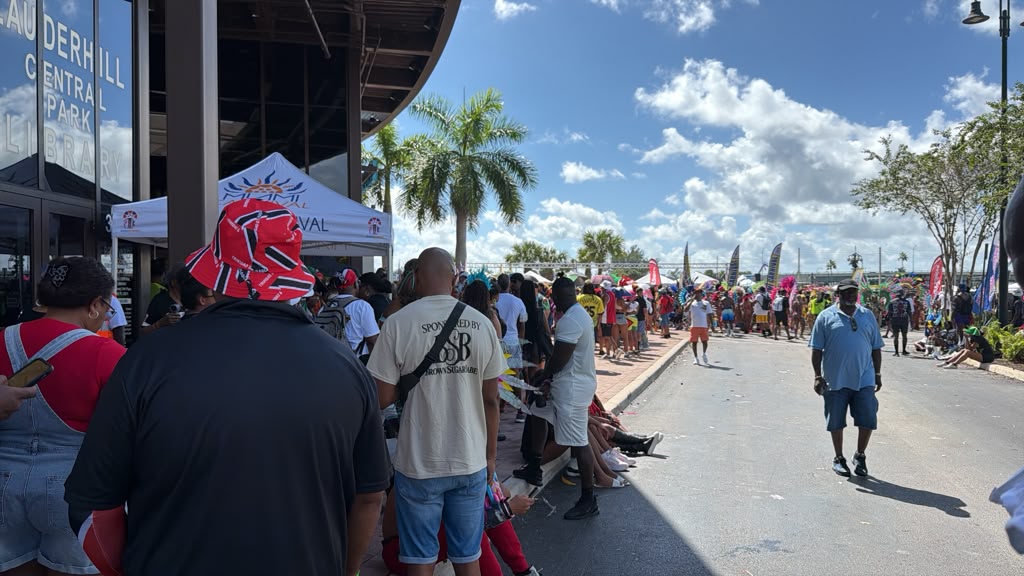
No water was provided. In previous years, organizers sent staff out in golf carts to distribute cold bottles to attendees waiting in line. This year, outside the fence, there were no misters, no water stations, no portable restrooms, and no shaded canopies. We were penned against metal barricades on the exterior grass like cattle.
My breathing grew shallow. As my condition noticeably worsened, fellow attendees in the queue saw that I was on the verge of physical collapse and began shouting at security, demanding that someone fetch a medic. Only after the crowd raised their voices in protest did a security guard reluctantly walk away into the park.
When he returned, he was not leading an EMS team. He was holding a cold, sealed bottle of water.
As I stood there leaning against the barrier, desperate for relief, he looked directly in the crowd, cracked the seal of the bottle, and began drinking it in front of me.
“Self-preservation baby,” he said.
Then, looking at the stranded crowd waiting outside the gates, he made a disparaging comment declaring that “niggers are never on time,” deliberately pronouncing it with a hard “-r.”
I was too weak to confront him. My body was failing, and I was forced to swallow that humiliation in silence. As someone who produces and manages live events, I know that your front-gate staff represents the heart and face of your entire organization. To contract security personnel who openly demean the culture and direct racial slurs at the very patrons paying to enter is an inexcusable failure of management and oversight.
When security finally pulled the gates open around 12:45 PM—an hour and forty-five minutes past schedule—there was no orderly intake. The massive crowd surged forward in an uncontrolled stampede. Working journalists had to physically shield their expensive camera bodies and lenses with their own arms to prevent them from being smashed into the steel barriers as bodies pushed through.
I never made it inside to cover the bands. My day ended inside an ambulance.
The emergency department at ED.FMF officially admitted me on October 11, 2026, for heat exhaustion. The hospital records tell the clinical reality of what those three hours did to my body:
- Admitting Diagnosis: Heat Exhaustion
- Clinical Findings: Cephalgia (severe head, neck, and facial pain)
- Hyponatremia: Abnormally low blood sodium concentration (under 135 mEq/L) resulting from dangerous physiological dilution while battling extreme heat.
I did not suffer a passing headache. My internal chemistry crashed while security guards watched me suffer and drank water in front of my face.
Part III: Widespread Breakdown and Administrative Paralysis
What happened to me at the gate was not an isolated breakdown; it was the outward face of an operational disaster that crippled the entire 2026 celebration.
NBC 6 South Florida dispatched reporter Isabella Martinez directly to Central Broward Park, where the broadcast captured the growing chaos on live television. The station’s cameras showed patrons fanning themselves, masqueraders sitting on the hot pavement in full regalia, and attendees desperately sheltering beneath damp towels. NBC 6 documented Lauderhill Fire-Rescue wheeling a female attendee away on a stretcher after she collapsed from heat exhaustion outside the entrance.
One attendee from Tampa told NBC 6:
“I drove like four and a half hours from Tampa to come to this Carnival, so I’m a little bit disappointed that I have to wait this long to get inside, and still waiting.”
Another frustrated patron standing beneath an umbrella emphasized the total lack of operational leadership:
“Somebody from the representatives should came out and speak to us. You know, it’s really crazy. I don’t like that. I mean, they came and gave us a little water, and thank God for that, but after an hour and forty-five minutes the gates opened, but the chaos didn’t end there.”
Across the community, the frustration echoed identical themes:
- Ashad of Bahamas Masqueraders gave the experience a harsh review:“This year was like 6/10 to me. New Music was at a 2/10 barely any played felt like an exact repeat of last year and the story told through the energy.”
- Theo Field, an attendee, publicly urged the host committee to adopt basic event logistics:“I’m making a recommendation to the Carnival committee:
- Have a designated entrance FOR MASQUERADERS ONLY.
- Designated entrance for Media.
- General Entrance.I was in line yesterday with Masqueraders, when they got to front of the line they turned them around and directed them elsewhere.”
- shellyseemoss documented that the problems followed attendees inside the park: “We definitely had a problem not just with entrance but with hydration having ice and cold water to drink and the bartenders not give you what you want yeah a big problem this year because if you’re drinking one liquor and you ask for that liquor they give you a different one that can make you sick… was displeased with that”
The parade itself ground to a halt. By 3:33 PM, massive sound and costume trucks were still frozen in staging positions, forbidden to move. The very first mas band did not cross the main judging stage until 5:27 PM—five and a half hours after the published noon start time. Masqueraders who paid thousands of dollars to dance down the road lost almost all of their daylight.
Part IV: The Public Statement and the Glaring Media Exclusion
Following public outcry, Asa P. Sealy of Aifos Agency, handling public relations for Miami Carnival, released an official graphic across social platforms titled “STATEMENT TO OUR COMMUNITY” from the Miami Broward One Carnival Host Committee:
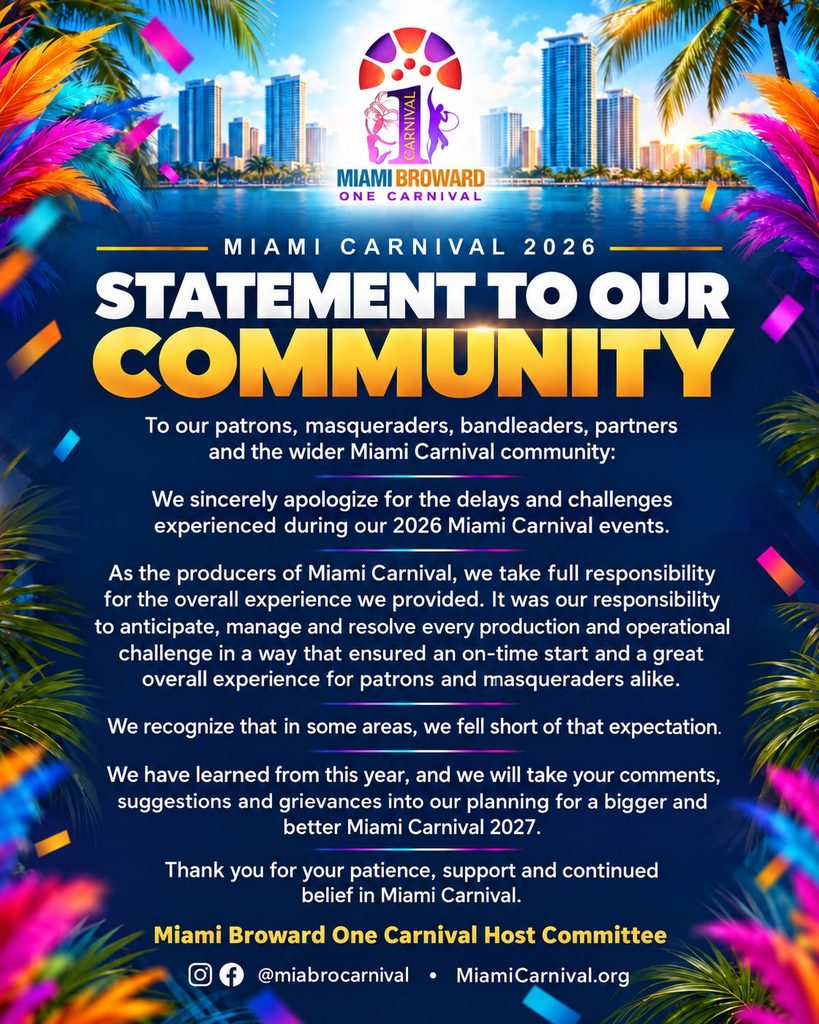
*”To our patrons, masqueraders, bandleaders, partners and the wider Miami Carnival community:
We sincerely apologize for the delays and challenges experienced during our 2026 Miami Carnival events.
As the producers of Miami Carnival, we take full responsibility for the overall experience we provided. Regardless of the production or operational challenges encountered, it was our responsibility to anticipate, manage and resolve them in a way that ensured our events opened on time and that every patron and masquerader received the experience they deserved.
We recognize that, in some areas, we fell short of that expectation.
Miami Carnival 2026 brought significant change, new circumstances and valuable lessons. We are listening closely to your comments, suggestions and grievances, and they will become an important part of our planning and operational review for 2027.
Our commitment is not simply to acknowledge what went wrong, but to learn from it, improve our processes and deliver a stronger, smoother and more enjoyable Miami Carnival experience for everyone.
To everyone who showed patience, supported us, celebrated with us and continues to believe in Miami Carnival, thank you.
We hear you. We appreciate you. And we are already looking ahead to a bigger and better Miami Carnival 2027.”*
Read that salutation again carefully: “To our patrons, masqueraders, bandleaders, partners and the wider Miami Carnival community:”
The working media were completely omitted.
The independent journalists, photographers, and videographers who spent their own money to fly down, rent vehicles, secure lodging, and stand for hours in the sun to tell the story of Miami Carnival were not granted a single word of public apology. Instead, media workers were sent a private back-channel message thanking them for their free promotion:
“Thank you all…truly!!! Thank you!!! The success of Miami Carnival 2026 was not just about what happened on the road or on the stage; you were an important part of it too. Through your photos, videos, interviews, stories and posts on your platforms, you helped us document the experience, amplify our voices and continue promoting Caribbean culture to audiences from all across the globe! We appreciate the partnership, the support and the work you put in throughout the season. It was a team effort, and we’re grateful to have had you with us. Much love and appreciation…see you all in 2027! 🇹🇹🎭”
You cannot solicit our unpaid labor to project an image of global cultural success while refusing to acknowledge publicly that your gate security denied us water, insulted our heritage, and refused us emergency medical care. That is not a partnership; it is exploitation.
Following the event, the South Florida Caribbean Bandleaders Association (@SFCBLA) announced an Instagram Live panel titled “After the Mas: Inside the Mas – Your Questions. Your Concerns. One Conversation,” acknowledging that “A LOT happened this Carnival season. We know there are concerns, unanswered questions, and some confusion.” The conversation had spilled beyond the park walls and could no longer be contained by public relations talking points.
Part V: Politics, Privilege, and the Real Duty of the Press
In the wake of the disaster, a broader conversation emerged regarding the political and municipal hurdles of producing Carnival in South Florida.
Cultural commentator zan__zan captured the deeper systemic reality:
“From delayed entry and the explanation revellers were given about ticket scanning to the long waits on the road and concerns about access to water in the South Florida heat, patrons deserve better. And it raises a bigger question: Are Caribbean people, particularly Black Caribbean people, getting the support and consideration we deserve in the very communities we help shape?”
The official miabrocarnival account responded directly, pointing to local government pushback:
“Thanks to Broward County Commissioner Hazelle P Rogers District 9 we secured a venue. And yes even in Lauderhill there is a force that doesn’t want our Cultural Celebration. The community needs to unite because some government officials say they support comes on our stage but in the background the message is different. Kudos to Commissioner Roger for being our torch holder.”
Attorney Marlon Hill noted the rigid regulatory inspections that stalled operations:
“Fire rescue and Police authorities will not open gates until all mas bands and/or vehicles are in place and passed their inspection. It is a collective effort to move the run of show. Very frustrating.”
Commentator clubbotnia added that municipal restrictions, stringent day-of-event safety checks, cracked-down visas for international contributors, and customs delays for costume materials all put immense pressure on organizers. In response, zan__zan affirmed that after 18 years in South Florida, “They don’t want to see us win. And that cuts deep.”
These systemic, municipal pressures are undeniably real. Caribbean culture frequently faces hostility, over-policing, and bureaucratic resistance from local municipalities that eagerly pocket our tourism dollars while treating our festivals as security liabilities.
Yet some attendees, such as Ken, attempted to dismiss the community’s outrage altogether, writing:
“I think ppl look for perfection and unrealistic expectations … voice your opinions and experiences but do it in a way that uplift the event and not tarnish the hard work and planning that it takes to put on this massive event that host thousands of people. Its obvious the organization heard the frustration and the fact that they put out that statement shows that open to criticism and feedback. But its so irritating that we can continuously complain about everything. As for me, I had a blast money well spent.”
It is easy to celebrate having “a blast” when you entered through an open gate, enjoyed the bar, and did not find yourself clinging to a fence begging for EMS support.
Expecting an event not to leave people collapsing in the heat without medical care is not “looking for perfection.” It is the bare minimum standard of human preservation.
Municipal roadblocks cannot excuse administrative neglect. The Fire Marshal did not force the host committee to leave media and patrons stranded in unshaded, unwatered queues without medical access. The City of Lauderhill did not instruct contracted gate security to drink water in front of a dying attendee and use racial slurs.
Those were choices made by staff operating under the authority of Miami Carnival.
I am not an influencer chasing free passes or VIP perks. As an independent cultural journalist, my allegiance belongs to the safety, dignity, and longevity of our community. Carnival is a space of freedom, resilience, and pride. When administrative negligence turns that sanctuary into a hazard that lands patrons in the emergency room, staying silent is not loyalty—it is complicity.
Miami Carnival 2027 must do far more than post apology letters and send out surveys. It must guarantee that no human being ever has to beg for their life outside its gates again.
Frequently Asked Questions
What caused the multi-hour delays at the Miami Carnival 2026 entry gates?
Delays were caused by a combination of uncoordinated gate personnel, slow perimeter operations, and mandatory float and vehicle inspections conducted by police and fire rescue officials before gates were permitted to open.
Were emergency medical services made accessible outside the venue?
No. Perimeter security staff initially refused to summon on-site EMS for an attendee experiencing severe heat exhaustion, advising them instead to walk off-site to a local commercial gas station.
What clinical conditions resulted from the heat exposure outside the gate?
Hospital records from ED.FMF confirmed diagnoses of heat exhaustion, cephalgia (severe head, neck, and facial pain), hyponatremia (abnormally diluted blood sodium under 135 mEq/L), and fatty liver following three hours trapped in the direct sun.
Were media workers included in Miami Carnival’s public apology?
No. The Miami Broward One Carnival Host Committee addressed its official public apology exclusively to patrons, masqueraders, bandleaders, partners, and the wider community, omitting the working press corps.